
How to convert audio to MIDI
Prepare one useful audio part, convert it, then fix the MIDI in your DAW.
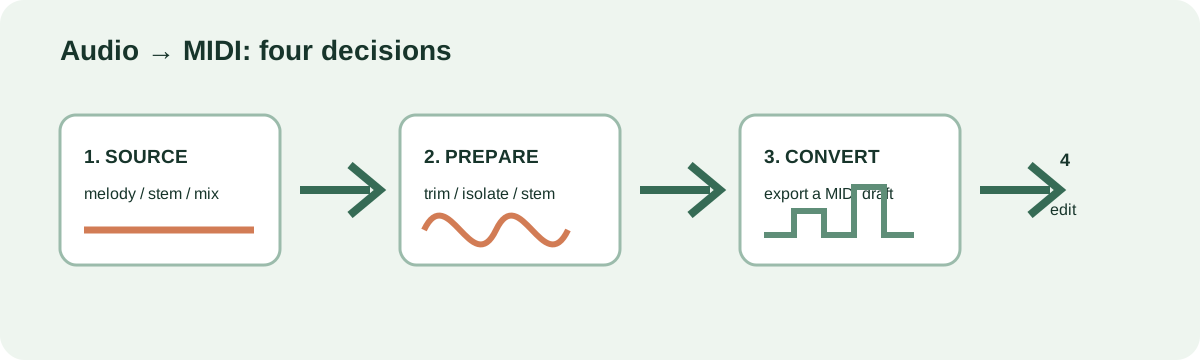
Use an isolated melody for the quickest browser conversion. For chords or a full song, separate the part you want first. No converter can turn a dense mix into a finished arrangement without an editing pass.
Step 1
Check the input against measured boundaries
Two tones can collapse
With a 220 Hz + 330 Hz dual-tone input, the detector returned one MIDI 45 event instead of two simultaneous pitches. This is a measured result from the local detector, not an accuracy claim for every recording.
More-notes setting
At sensitivity 1, the same 3-second, 0.04-amplitude input produced MIDI 45 from 0.0058 s to 2.9722 s. The note count stayed at one.
Fewer-notes setting
At sensitivity 3, that exact input still produced one MIDI 45, but from 0.0348 s to 2.9489 s. The threshold changed the boundaries, not the collapsed pitch count.
Step 2
Make the input easier to read
- Trim silence at the start and end so the note timeline begins where the performance begins.
- Keep the source part exposed. A clean WAV is useful, but a lossless format cannot fix overlapping instruments.
- Leave vibrato, slides, and expressive timing in the source if you want them represented; plan to inspect the resulting short notes and bends.
- For a full mix, separate the stem before conversion and keep the original beside the separated file for comparison.
Step 3
Use the dual-tone reading to choose the repair
Keep the source and export together, then apply the repair that matches this new measured signature:
- Collapsed chord: compare the MIDI note count with the number of simultaneous tones you fed in. One MIDI 45 for 220 Hz plus 330 Hz means the chord needs a different workflow or manual note entry.
- Boundary shift: sensitivity 1 opened the event at 0.0058 s and sensitivity 3 at 0.0348 s. Preserve the source attack before quantizing either edge.
- Held-note end: the same settings ended at 2.9722 s versus 2.9489 s. Check the release against the audio instead of assuming the longer event is correct.
- Reproducibility: log the dual-tone frequencies, 3-second duration, 0.04 amplitude, sensitivity level, pitch, and start/end times beside the MIDI.
This is a measured dual-tone boundary case for the local detector. It is evidence about this input and settings, not a universal instrument accuracy percentage.
Quick answer
What should you convert first?
Start with the cleanest isolated part you can export. If that part works, continue with the rest of the stems. If it does not, changing brands before checking the source usually hides the real problem.
Read the polyphonic separate, convert, repair workflow