Clean melody
Free first pass
Try Basic Pitch, Jukeblocks, or Local MIDI, then check bends and note joins.
 Local MIDI
Audio to MIDI converter
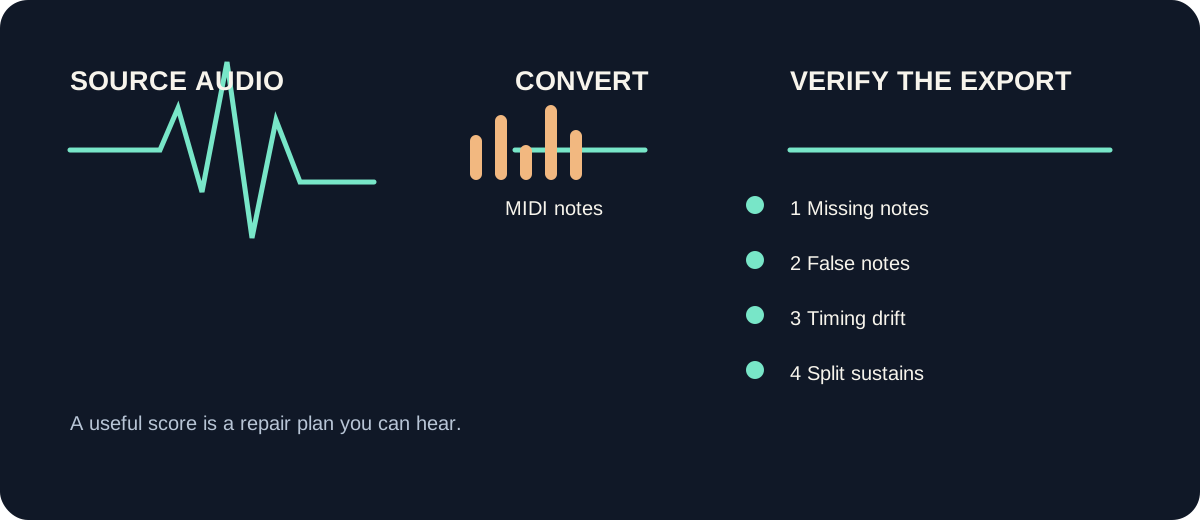
Short answer: use Basic Pitch or Jukeblocks for a clean single line; use a workflow with explicit stem or note editing for chords and full mixes. Every export needs a DAW check for missing notes, false notes, timing, and split sustains.
Melody: start with a free browser pass. Polyphony: separate parts or choose a deeper editor. Do not trust a headline score until the same passage survives the four checks below.
One consistent test language
| Tool | Single-note material | Chords / full mix | What to verify after export |
|---|---|---|---|
| Jukeblocks | Its page says single instruments, vocals, and piano work best. | Dense mixes need editing; its Recreate workflow offers separate bass, chords, and melody tracks. | False notes and edits in dense passages. |
| AI-MIDI | Models expose pitch, dynamics, and sustain controls; Piano and Guitar are listed. | Multi is marked beta/paid; no hard accuracy number is published. | Model choice, missing notes, and sustain behavior. |
| Basic Pitch | Designed for single-instrument audio with pitch-bend detection. | It is not presented as a full-mix stem separator. | Bends, quiet notes, and note joins. |
These are page claims and workflow descriptions, not a shared benchmark. The useful comparison starts when you inspect the same bar in the exported MIDI.
Measured on Local MIDI
| Input | Observed output | Meaning in a DAW |
|---|---|---|
| Pure 40 Hz sine | One note: MIDI 89 (about 1397 Hz), 1.974 s. | A low tone can arrive as a high, wrong-octave event. |
| Pure 1550 Hz sine | One note: MIDI 79 (about 784 Hz), 1.974 s. | A high tone can arrive roughly an octave low. |
| 440 Hz with ±150-cent vibrato at 6 Hz | 23 notes, alternating MIDI 68 and 70, about 0.075–0.093 s each; highest sensitivity produced 0 notes. | One held sound becomes short fragments—or disappears at a stricter threshold. |
Conditions: 44100 Hz mono, 2 seconds, pure sine, no harmonics or noise. These are measured Local MIDI readings, not a claim about every instrument. The hard boundaries to watch are below 55 Hz, above 1400 Hz, and strong vibrato or bends.
DAW check
| Reading | Count this | Choose the workflow when… |
|---|---|---|
| Missing notes | Source notes absent from MIDI | Quiet notes or dense chords matter. |
| False notes | MIDI events with no source match | You need a fast piano-roll cleanup. |
| Timing | Starts/ends drifting from the source | Pitch is right but the groove is not. |
| Split sustains | One held sound exported as fragments | Vibrato, slides, or thresholds are present. |
Workflow choice
Free first pass
Try Basic Pitch, Jukeblocks, or Local MIDI, then check bends and note joins.
Inspect every bar
Use a workflow that exposes separate parts or lets you correct notes directly.
Separate first
Stem-separate before conversion when overlapping instruments make attribution ambiguous.